
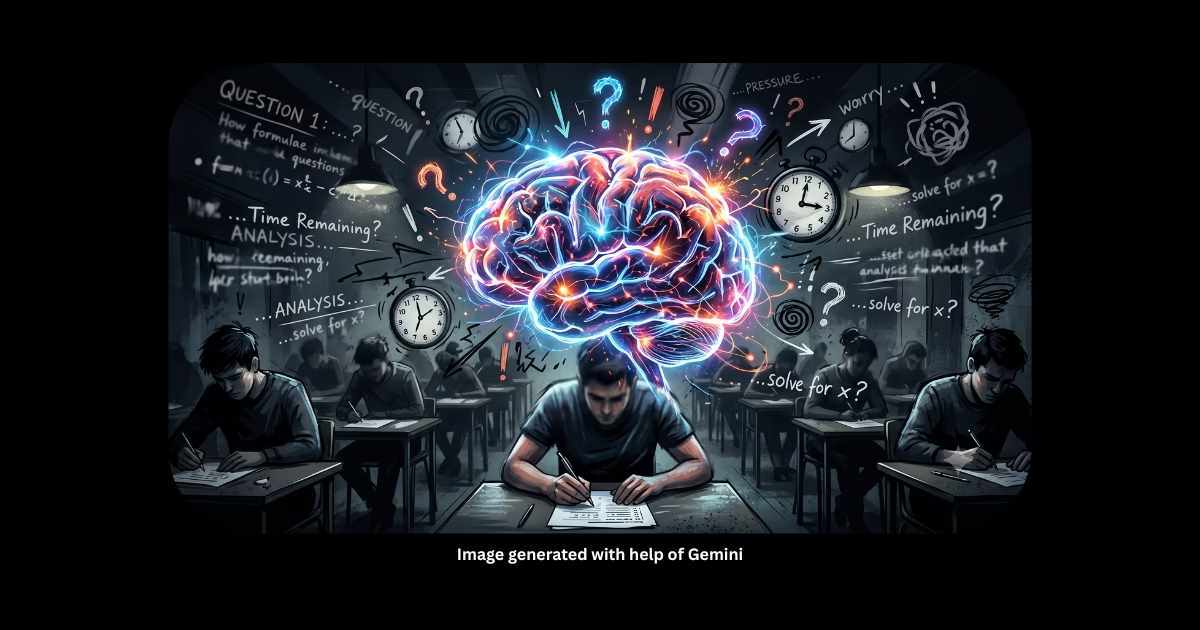
Have you ever felt like you struck a mental wall when sitting in front of a test, pencil poised? The solution doesn’t seem to be materialising, even though you know it’s just a whisper away. This isn’t merely an annoying occurrence; it’s a prevalent one that science can explain. You might think your memory is playing tricks on you, but studies in psychology show that’s not always the case. In most cases, a more intricate interaction between stress, attention, and the brain’s information retrieval mechanisms is at work.
The Brain’s Fight-or-Flight Response Kicks In
When confronted with a high-stakes circumstance, such as an exam, our bodies and brains instinctively shift into protection mode. This is more than just being nervous; it is a deeply rooted evolutionary response designed to protect us from perceived threats.
An Overactive Amygdala Steals the Show
Deep in your brain there’s a little almond-shaped structure called the amygdala. It’s like having an alert system in your head.” This amygdala becomes very active when you are under strain it is screaming “Danger! Danger! Its major function is to process emotions, notably fear and anxiety. This alarm is handy for dodging a rushing car, but not so beneficial when you’re attempting to recollect the nuances of historical events or a complex arithmetic formula. The more intense the stress, the more intense the alert in the amygdala, and the more it seeks to hijack.
Cortisol Floods the System
Upon the activation of the alarm, your body secretes stress chemicals, chiefly cortisol. Cortisol is frequently associated with chronic stress. A positive aspect that is excessively indulged in can quickly become a problem. Your ability to retrieve extant memories may be impaired by elevated cortisol levels. It is akin to endeavouring to navigate through a dense fog; the information is present, but it is obscured. The prefrontal cortex, the brain region responsible for executive functions such as decision-making, planning, and, most importantly, information retrieval, can be disrupted by the increase in cortisol.
Retrieval Failure: The Information Is There, But the Path Is Blocked
It’s not that the information has vanished from your brain entirely. It’s more like your brain has temporarily lost the map to find it. Experts often refer to this as retrieval failure.
Weak or Insufficient Retrieval Cues
Imagine that memories are like books in a big library. You will need the right cataloguing system or a good list of keywords to find a certain book. The brain calls these “keywords” recall cues. They can be anything that helps you remember something, like a smell, a sound, a feeling, or even a word in the test question. Finding the right “book” on a test is harder if the retrieval cues don’t quite match how you stored the information or aren’t strong enough. When we’re stressed, our brains may not be able to handle these cues as well, which can make it even harder to find what we need.
Tip-of-the-Tongue Phenomenon on Steroids
We’ve all been there: that annoying “tip-of-the-tongue” moment when you know you know a word or a name but it just won’t come out. It is a more extreme variant of going blank in an exam. Your brain is pulling up bits and pieces of the memory, maybe the first letter or a broad idea, but it can’t quite put the whole thing together. This occurs regularly when information is less frequently accessed or stored in close proximity to other similar information, which causes interference. And when you’re under the gun of a test, the sensation is amplified and it seems like a whole black hole of memory rather than simply a brief block.
The Role of Working Memory Overload
Our working memory is like a mental scratchpad where we actively hold and manipulate information for a short time. It’s what allows you to remember a phone number someone just told you before you dial it.
Too Many Thoughts, Not Enough Space
Exams can put a strain on your working memory. All the while, you’re fretting over the time, the difficulty, and your potential grade while you read the question, attempt to comprehend it, recall pertinent facts, and formulate an answer. The limited capacity of your working memory might be swiftly overwhelmed by this mental juggling act. Overload makes it less efficient at processing new information and even at accessing long-term memories. When you try to install too many apps on an outdated phone all at once, performance drops and some apps won’t even launch.
Distraction Becomes a Major Brain Drain
Anxiety and stress are incredibly distracting. Your mind might start to loop on thoughts like, “I’m going to fail,” “Everyone else seems to be writing,” or “I should have studied more.” These intrusive thoughts take up valuable space in your working memory, leaving less room for the actual task at hand: answering the question. This internal noise effectively drowns out the quiet signals your brain sends when trying to retrieve an answer.
The Impact of Attention and Focus
Our ability to focus plays a huge role in how we perform academically, and especially during exams. When your attention wavers, so does your performance.
The Spotlight Effect on Your Brain
Imagine your attention as a spotlight. When you’re calm and focused, that spotlight is pointed precisely at the information you need, illuminating it clearly. But under stress, that spotlight starts to flicker, dance around erratically, or even dim significantly. Your attention might become too broad, trying to take in too much at once, or it might become too narrow, fixating on the anxiety itself rather than the question. This diffused or hijacked attention prevents your brain from effectively encoding new information or efficiently retrieving stored knowledge.
Selective Attention and Information Overload
Sometimes your brain might selectively attend in a desperate attempt to uncover the answer, but not helpfully. It may latch onto unimportant elements in the inquiry or a partially recalled piece of knowledge and not be able to step back and see the wider picture. This can lead to a kind of ‘information overload’ where you are processing too much but none of it is bringing you to the appropriate solution. It’s like searching desperately for your keys, but only checking beneath the couch cushion you had checked five times instead of expanding your search to the whole room.
What You Can Do When Going Blank: Practical Strategies
While understanding why you go blank is helpful, knowing what to do in the moment can make a real difference. These aren’t magic fixes, but they can help to regulate your internal state and allow your brain a better chance at retrieval.
Regulating Your Breath and Body
One of the quickest ways to calm your nervous system is through your breath. When you feel that panic starting — the kind that can also stem from unresolved exam failure trauma — try this:
- Deep Diaphragmatic Breathing: Place one hand on your chest and one on your belly. Breathe in slowly through your nose for a count of four, feeling your belly rise. Hold for a count of four. Exhale slowly through your mouth for a count of six, feeling your belly fall. Repeat this a few times. This type of breathing tells your brain that you’re safe, activating your parasympathetic nervous system, which is responsible for “rest and digest” rather than “fight or flight.”
- Progressive Muscle Relaxation (brief version): Tense a group of muscles (like your shoulders) for a few seconds, then completely release them. Do this with a few different muscle groups. This can help release physical tension that often accompanies mental stress.
Shifting Your Focus and Perspective
Once your body is a bit calmer, you can try some mental adjustments.
- Change of Scenery (mental): If you’re stuck on a question, skip it for a moment. Move on to an easier one or just doodle a bit. Giving your brain a brief “reset” can allow the information to surface when you return to the tricky question. Sometimes, moving through other questions can even provide a beneficial retrieval cue for the earlier, blocked one.
- Reframing the Situation: Instead of thinking, “I’m going to fail,” try to reframe it as, “This is a challenging moment, and I can handle it.” Remind yourself that one blank moment doesn’t define your entire performance or your intelligence. Acknowledge the feeling without letting it consume you.
- Brain Dump (if allowed): If permitted, quickly jot down any related keywords, concepts, or formulas you do remember for that question on a scrap piece of paper. Even incomplete thoughts can sometimes kickstart the full memory. This also offloads some of the burden from your working memory.
- Visualize Success (briefly): Take a quick moment to visualize yourself confidently answering the question. This can help shift your mental state from one of panic to one of competence — the same kind of shift that positive mindset coaching builds before you even walk in.
Preparation Beyond Rote Memorization
While knowing your stuff is fundamental, how you prepare also matters.
- Spaced Repetition: Instead of cramming, review material over longer periods. This strengthens memory traces and makes information more accessible. Tools like flashcards or apps that utilize spaced repetition can be really helpful.
- Active Recall: Don’t just passively reread notes. Actively test yourself. Try to recall information from memory before looking at your notes. This simulates the exam environment and strengthens your retrieval pathways.
- Practice Under Pressure: If possible, do timed practice tests to get used to the pressure. This helps desensitize you to the stress and allows you to practice your coping mechanisms before the real thing. It can also highlight areas where you might get stuck, allowing you to address them proactively.
- Understand, Don’t Just Memorize: When you truly understand a concept, rather than just memorizing facts, you have multiple ways to access that information. If one retrieval path is blocked, another might be open. Interconnecting ideas builds a stronger, more resilient memory network.
So, a blank in an exam, in short, doesn’t always mean a memory lapse or not knowing stuff. It’s usually a brief hiccup in your brain’s retrieval machinery, deeply tinged with tension and anxiety. By knowing these systems and doing some strategic interventions, you can get through those high-pressure moments and give your brain the best shot at showing what it really understands. So next time this happens, remember this: you haven’t forgotten anything, your brain just needs a little calm confidence to unlock what’s already there.